When I think about the student experience in higher education, I keep coming back to a simple question.
Why is it so difficult for students to get things done at institutions designed to help them succeed?
A student wants to change her major. Her advisor sends her to another department. Financial aid sends her somewhere else. The registrar has a hold on her account because of a library fine she paid months ago.
Three weeks and four offices later, she gives up and stays in a major she doesn’t want.
Nobody deliberately designed that experience. It accumulated over time.
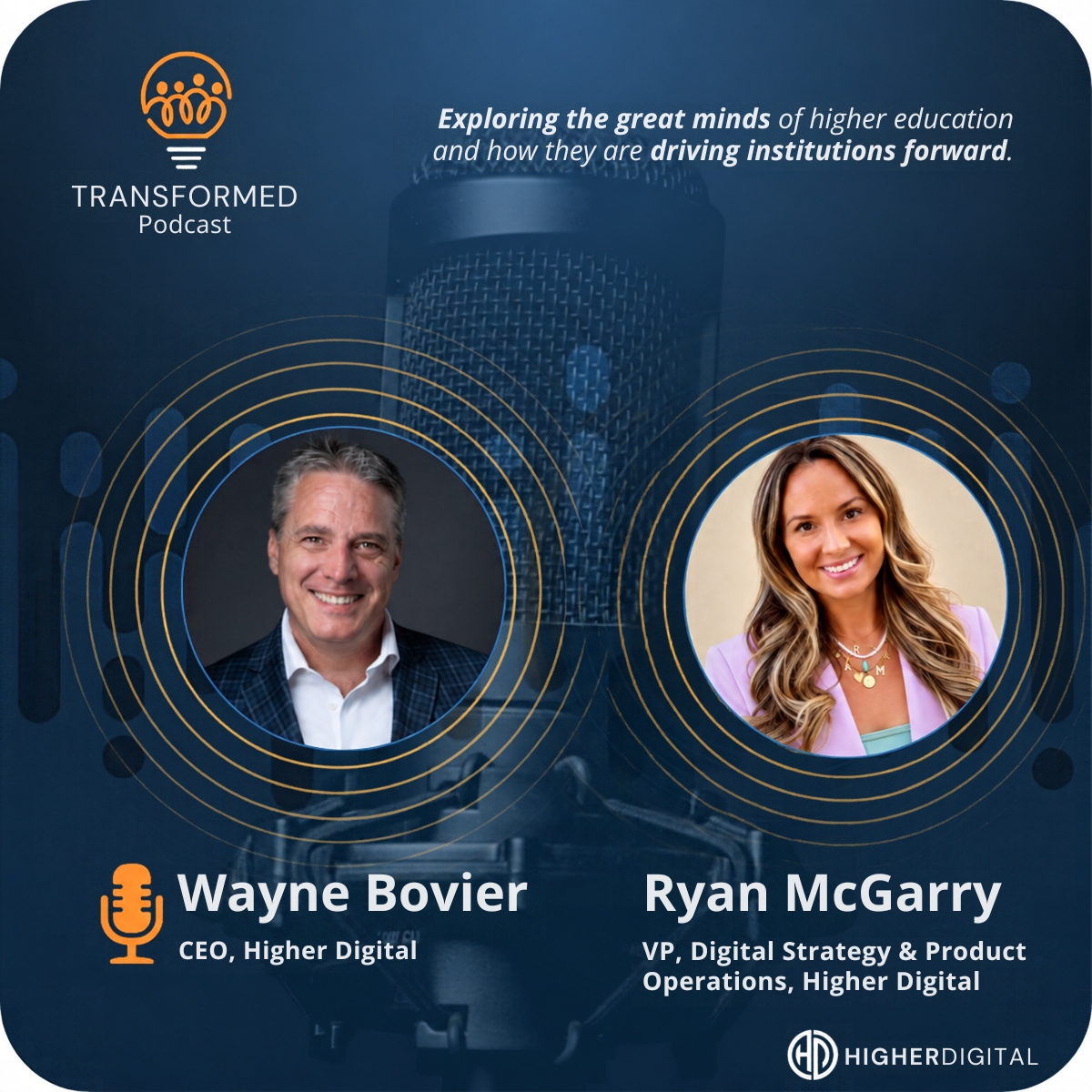
That was one of the central ideas in my conversation with Ryan McGarry, VP of Digital Strategy and Product Operations at Higher Digital. We explored how institutional silos create unnecessary friction for students and staff, why journey mapping can reveal problems that individual departments never see, and where AI could help institutions connect the pieces.
Because the student doesn’t experience four separate offices.
The student experiences one institution.
And that distinction matters more than many institutions realize.
Every Department Can Be Working. The Institution Can Still Be Failing.
Universities are organized around departments, systems, policies, committees, and reporting lines. Each has a purpose. Each has people doing important work. And each may be operating exactly as intended.
But what happens when a student needs to move between them?
A simple request can become a complicated journey. An advisor provides one piece of information. Financial aid requires another step. A form needs to be submitted elsewhere. A hold prevents the student from moving forward, even when the underlying issue has already been resolved.
From the institution’s perspective, these may be separate processes with reasonable explanations.
From the student’s perspective, they’re obstacles standing between them and something they need to accomplish.
Ryan and I discussed how leadership teams can expose these problems by following a student’s actual journey across departments, from beginning to end.
The exercise is often uncomfortable, not because someone necessarily did something wrong, but because nobody has examined the entire experience together.
Every department can be performing well while the institution is still failing the student.
That should change how we think about institutional performance. Departmental efficiency matters, but it doesn’t automatically translate into an effective student experience.
The Distance Between Departments Has a Cost
It’s easy to recognize the cost of a failed technology implementation or a major operational breakdown.
The smaller, everyday costs are harder to see.
A staff member spends time chasing a hold. Someone rekeys information already entered into another system. An advisor explains a policy to a student who has already spoken to two other offices. A student repeats the same story because each department has only part of the picture.
Individually, these tasks might seem manageable.
Across an institution, they can consume a significant amount of time.
And the cost isn’t limited to staff productivity. Every unnecessary handoff creates another opportunity for confusion, delay, frustration, or disengagement.
This is why I think institutions need to look beyond whether individual departments are meeting their targets.
They also need to ask how much effort it takes for a student to accomplish something that should be straightforward.
How much of the institution’s capacity goes into moving students between offices rather than helping them move forward?
That question can reveal problems that traditional departmental reporting won’t.
Start With the Student’s Actual Journey
The good news is that institutions don’t need to redesign every process at once.
Ryan offered a practical starting point: choose one question students ask repeatedly.
It might be how to drop a class without losing financial aid. It might be how to resolve a registration hold or complete a particular administrative process.
Then bring together one representative from every office involved.
Read the student emails. Look at the questions people are asking and the language they use to describe their problems. Open the institution’s website, complete the forms, follow the links, and walk through the process as if you were the student.
Don’t assume the published instructions tell the whole story. Follow the actual steps.
Where does the process become confusing? Where does information have to be entered twice? How many times does the student have to explain the same situation? Which steps exist because they genuinely add value, and which have accumulated without anyone reconsidering them?
These questions turn an abstract discussion about improving student experience into something the institution can examine and act on.
And if journey mapping has already been done, the institution may not need to start from scratch. It may simply need to return to work that stalled and put the findings into practice.
The important thing is to move beyond identifying friction and actually resolve it.
AI Could Become the Integration Layer Higher Education Needs
This is where the conversation becomes particularly interesting.
Higher education has invested heavily in technology, but having multiple systems doesn’t necessarily mean those systems work together in ways that make life easier for students.
Too often, students become the integration layer.
They carry information between offices, repeat their stories, upload documents more than once, and try to understand how different policies affect the same situation.
Ryan sees an opportunity for AI to take on some of that connective work.
AI could help carry information between offices, bring answers together in one place, explain policies in plain language, and identify recurring questions before they become another source of frustration.
Imagine a student who needs an answer late on a Friday evening. Instead of navigating several websites and trying to reconcile different instructions, the student could receive a clear explanation informed by the relevant information.
AI could also help institutions recognize patterns that are difficult to see when information is scattered across departments. If the same question keeps appearing throughout a semester, that repetition may signal a process that needs to change, not simply another question that needs answering.
But the goal shouldn’t be to add AI to a broken process and call it transformation.
If the underlying information is unreliable or the process itself makes little sense, automation may simply help the institution deliver the same frustrating experience faster.
The opportunity is to use AI alongside better processes and stronger connections between the people and systems involved.
Not Every Decision Should Be Automated
There is an important distinction between helping a student understand a policy and deciding what that policy means for their individual circumstances.
AI can explain requirements, retrieve information, and guide students through routine processes.
But what happens when a student is in crisis? What if they’re making a consequential decision about whether to change their major, continue their studies, or take another path?
Those moments require more than an accurate explanation.
They require judgment, context, and an understanding of the person involved.
Ryan’s perspective is that AI should handle more of the explanatory and connective work so people can focus on the situations where human involvement matters most.
That distinction is essential.
The purpose of AI in higher education shouldn’t be to remove people from every interaction. It should be to reduce unnecessary work and make it easier for people to provide meaningful support when students need it.
Technology should make the human experience better, not simply make the institution more automated.
Transformation Starts With a Different Question
One of the biggest challenges in institutional transformation is that we tend to begin with what already exists.
We look at our departments, systems, policies, and organizational structures. Then we ask how to improve them.
Those questions have their place. But they can also limit the solutions we consider because they assume the existing structure is the right starting point.
A more useful question might be this:
If we were designing this process today around what the student is trying to accomplish, would we build it this way?
That question forces the institution to examine the experience rather than defend the structure.
It doesn’t mean every policy is unnecessary or every handoff can be eliminated. Institutions have legitimate requirements around compliance, security, financial aid, academic standards, and accountability.
But those requirements shouldn’t prevent leaders from identifying needless complexity.
The challenge is to distinguish between the steps that protect the institution and support students, and the friction that exists simply because nobody has reconsidered how the work fits together.
A Final Thought
Higher education doesn’t need to choose between effective institutional operations and a better student experience.
The two should reinforce each other.
When departments share information, processes make sense from beginning to end, and staff spend less time chasing information, institutions can use their resources more effectively while making it easier for students to accomplish what they came to do.
AI offers new possibilities for connecting systems and reducing repetitive work. But the starting point isn’t the technology.
It’s understanding the student’s experience, identifying where the institution creates unnecessary friction, and bringing the right people together to fix it.
Because students don’t care how many departments were involved in solving their problem.
They care whether the problem gets solved.
And if an institution wants to improve that experience, it has to stop looking only at the individual pieces and start paying attention to the distance between them.
- Wayne
Subscribe to TRANSFORMED wherever you get your podcasts to hear from higher ed leaders as soon as new episodes drop.