
Strategic Portfolio Management
STRATEGIC PORTFOLIO MANAGEMENT
From Strategic Intent
to Institutional Progress
We help presidents and CIOs align priorities, investments, and execution, so strategy actually moves.
OVERVIEW
What Is Strategic Portfolio Management?
Strategic Portfolio Management (SPM) connects strategy, investment, governance, and capacity into one coordinated view, so leadership can decide not just what to start, but what to stop. Gartner and Forrester recognize it as an emerging enterprise discipline.
It exists because traditional planning and project management can’t keep up. Everything is happening at once, and leadership needs a way to decide what matters.
SPM brings clarity to that complexity, so leaders can prioritize, act, and move forward with confidence.
SPM manages five dimensions together:
Priorities
Which initiatives matter most, and how they connect to strategy.
Investments
Where resources actually go, and whether that matches priorities.
Governance
How decisions get made about what moves, waits, or stops.
Capacity
The realistic ability to execute, given current commitments.
Tradeoffs
The cost of saying yes, and who owns that decision.
Higher Digital is the global leader in SPM for higher education.
WHY HIGHER ED IS DIFFERENT
The Context
Enterprise portfolio tools assume centralized authority, predictable funding, and a single P&L. Higher education has none of these.
Shared Governance
Decisions require consensus across faculty senates, cabinet, and boards. No CIO can mandate adoption the way a corporate VP can.
Budget Complexity
18-month cycles, restricted funds, enrollment-dependent revenue, and competing demands from every division, measured over years rather than quarters.
Mission Over Margin
Success isn’t measured in revenue growth. It’s measured in student outcomes, research impact, and community trust: the metrics that matter most in higher education.
THE DATA
Less Margin for Misaligned Work
Financial pressure, enrollment shifts, and stretched teams leave little room for initiatives that don’t serve the strategy.
Average tuition discount rate for first-time, full-time undergraduates at private nonprofit colleges.
NACUBO, 2025 Tuition Discounting Study (2025-26 preliminary)Projected decline in U.S. high school graduates by 2041, after the 2025 peak.
WICHE, Knocking at the College Door (2024)Higher education employees likely to look for a new job in the next year.
CUPA-HR, Higher Ed Employee Retention Survey (2025)Americans with a great deal or quite a lot of confidence in higher education, down from 57% in 2015.
Gallup and Lumina Foundation (2026)THE CHALLENGE
The Execution Reality
Strategy documents get approved. Then nothing happens.
Siloed Priorities
Academic affairs, IT, finance, and student success each run their own priority lists, each with a separate view of the portfolio.
Invisible Progress
Presidents and provosts can’t see which initiatives are advancing, which are stalled, or which are quietly draining resources.
Reactive Decisions
Without real-time portfolio data, leadership responds to the loudest voice instead of the highest-impact need.
Lost Momentum
Initiatives stall in committee, lose champions between budget cycles, and quietly fade without accountability.
WHAT WE SOLVE
What We Solve in Higher Education
Strategic Portfolio Management is not project management. It’s not another governance layer. And it’s not just an IT tool.
Prioritize What Truly Matters
Continuously decide what matters right now, informed by institutional strategy, not politics.
Fund What Advances the Mission
Align investment to institutional priorities with transparent tradeoff analysis.
Execute What Moves Forward
Staff and execute what’s been committed, with accountability across every division.
Stop What No Longer Serves
Say ‘not yet’ with confidence and transparency, backed by portfolio-level evidence.
HOW WE WORK
Our Approach to Strategic Portfolio Management
You don’t need another methodology. You need a clearer way to move forward.
We bring structure to what already exists, aligning priorities, governance, and execution into a single, visible system of action.
Make Priorities Real
Translate strategy into a clear, actionable portfolio tied to outcomes, with every initiative linked to a result.
Create Shared Visibility
Give leadership a single view across initiatives, dependencies, risks, and progress.
Strengthen Decision-Making
Establish governance that enables faster, more confident decisions across silos.
Align Teams to Execution
Ensure leaders, project teams, and stakeholders are working from the same priorities and direction.
Build Change Capacity Over Time
Improve how the institution executes, along with what it takes on.
WHERE SPM LIVES
Where SPM Lives and Who Owns It
SPM lives wherever priorities require coordination. Most institutions start at one level and expand as governance matures.
Ownership varies by institution. Visibility and coordination are constant.
WHY THIS WORKS
Built Around Your Institution
We don’t introduce heavy frameworks or ask you to start over. We work within your existing systems, teams, and constraints, bringing the structure and discipline needed to move forward with confidence.
This approach is grounded in what we’ve seen work across 300+ institutions, helping leadership teams coordinate action under pressure and turn strategy into measurable progress.
THE PLATFORM
Introducing (SEA)results®
(SEA)results® is the only SPM platform designed exclusively for higher education, paired with the consulting expertise to make it stick.
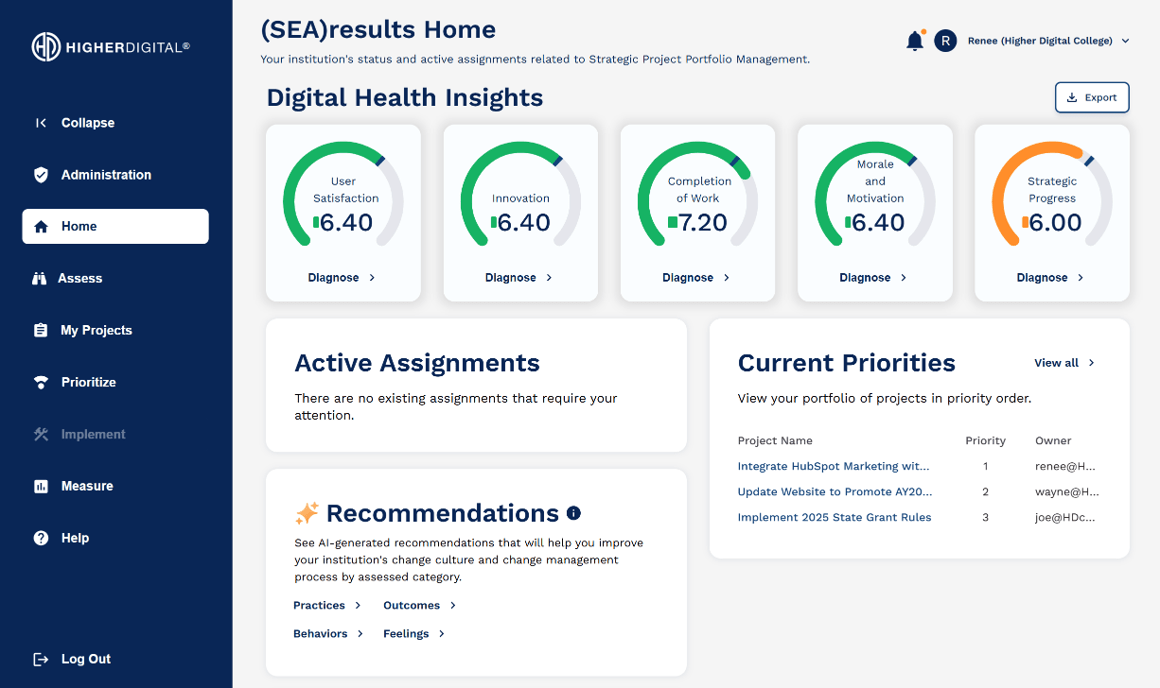
SPM is the discipline. (SEA)results® is the platform. Higher Digital is the partner.
Our advisors build SPM into your governance and leadership culture. (SEA)results® keeps the portfolio visible and moving, every cycle.
Explore (SEA)results®Start with a free assessment. Get Your Strategy Score →
PROOF IN PRACTICE
Trusted by Institutions in the U.S. and U.K.
Institutions partner with Higher Digital to align strategy to execution and keep the portfolio moving.











“Higher Digital’s change management assessment and User Experience (UX) work changed our culture, overnight.”
Dan Ewart, Vice President of IT & CIO
University of Idaho
Read the Idaho story →SPM in Action
IS YOUR INSTITUTION READY?
Four Questions for Your Next Cabinet Meeting
Ask each question and listen to the conversation. The answers reveal more about your SPM readiness than any formal assessment.
If each leader listed our top five priorities right now, would the lists match?
Do we share a current view of every active initiative: moving, stalled, or deprioritized?
Do we weigh each new initiative against existing commitments in a visible, consistent way?
Where are we most capacity-constrained, and does leadership see it clearly?
Score your SPM readiness
Rate strategic clarity, portfolio visibility, governance alignment, capacity awareness, and execution discipline from 1 to 5. A total below 15 signals a significant opportunity. For a benchmarked view, take the free 10-minute Strategy Score, benchmarked against 600+ strategic plans.
Get Your Strategy ScoreFAQ
Common Questions About Strategic Portfolio Management
What is strategic portfolio management?
Strategic Portfolio Management (SPM) connects strategy, investment, governance, and capacity into one coordinated view, so leaders can decide what to start, what to continue, and what to stop. Gartner and Forrester recognize it as an emerging enterprise discipline.
How is SPM different from project management?
Project management asks whether the work is being done right. SPM asks whether the institution is doing the right work, by looking across priorities, investments, governance, capacity, and tradeoffs together.
How is SPM different in higher education?
Higher education runs on shared governance, multi-year budget cycles with restricted funds, and success measured in student outcomes, research impact, and community trust. A decision a corporate COO makes in an afternoon may need committee review, faculty input, presidential approval, and board notification. SPM for higher education is built around those realities.
Where does SPM live, and who owns it?
SPM can run at four levels: a single enterprise initiative, a division, the full institution, or a district or system. Ownership often sits with the president or chancellor, a chief of staff, the provost, the CIO, the CFO, or a chief strategy officer. What matters is that someone owns it, with an executive sponsor.
When should an institution adopt SPM?
Common triggers include a new strategic plan, a major transformation such as an ERP implementation or accreditation, a new president, provost, or CIO, initiatives that launch but stall, too many initiatives for the capacity available, and AI accelerating decision pressure. If more than two sound familiar, the coordination gap is likely real.
Is SPM right for every institution?
SPM works best when leadership agrees that priorities need coordinating, an executive sponsor champions the effort across governance, and the institution has room for operational improvement work. Institutions looking mainly for a project management tool may be better served starting there.
How do SPM and (SEA)results work together?
SPM is the discipline. (SEA)results® is the platform. Higher Digital is the partner. Our advisors build SPM into your governance and leadership culture, and (SEA)results keeps the portfolio visible and moving, every cycle.
Do we need a new methodology to adopt SPM?
We work within your existing systems, teams, and constraints, bringing the structure and discipline to move forward, grounded in what has worked across 300+ institutions.
How do we get started?
Take the free 10-minute assessment, benchmarked against 600+ strategic plans, or talk with an SPM advisor.
Built for this moment. Trusted for what’s next.
Strategic Portfolio Management designed exclusively for higher education.
Prefer to start on your own? Benchmark Your Strategy →Free 10-minute assessment, benchmarked against 600+ strategic plans.