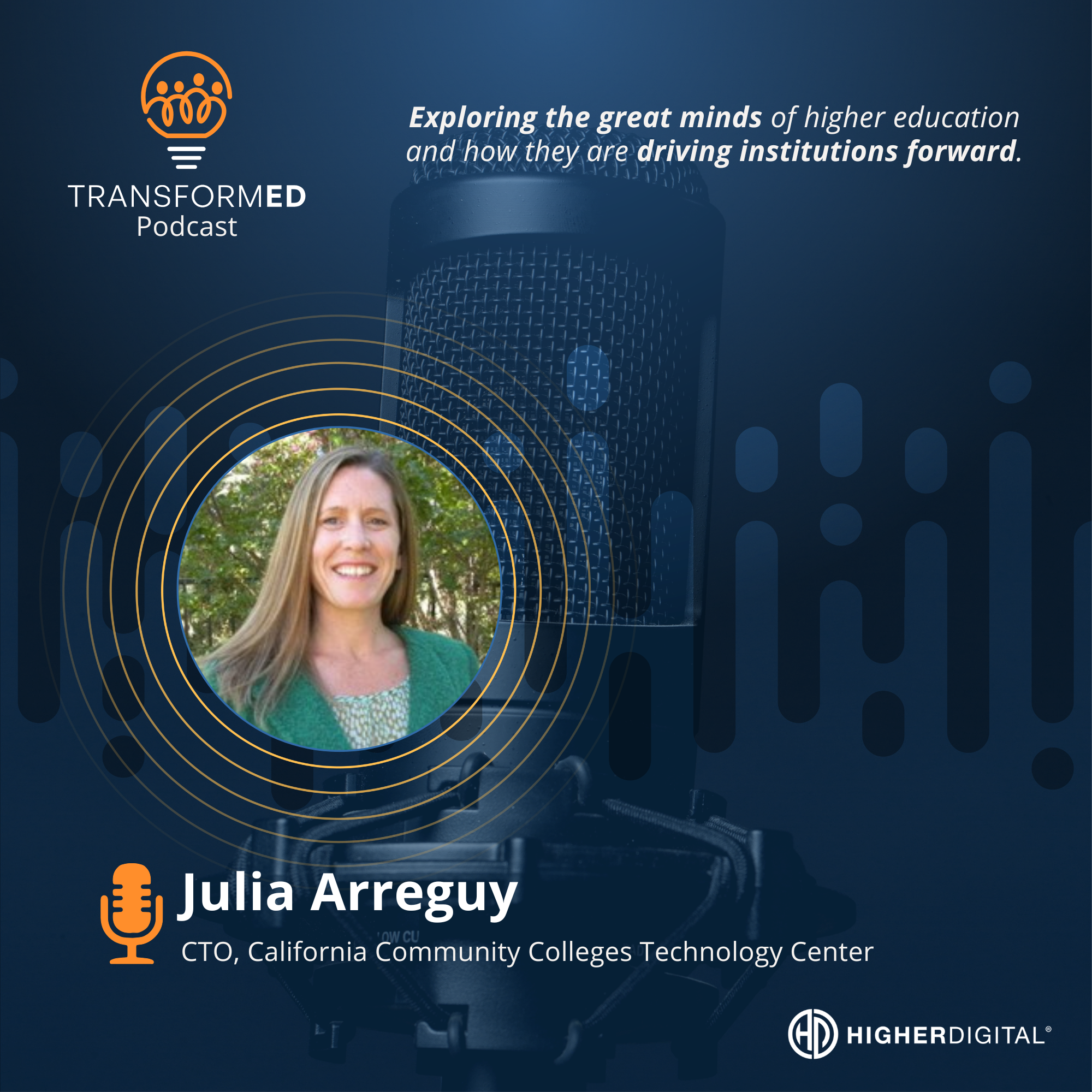
Higher Digital CEO & Co-Founder Wayne Bovier sits down with Julia Arreguy, Chief Technology Officer at the California Community Colleges Technology Center, to explore why technology projects in higher education often stall long before the technology itself becomes the problem.
Technology Is Difficult. Organizational Change Is Harder.
One distinction Julia made stood out.
Technology work is difficult. The teams designing, implementing, securing, and supporting systems solve complex problems every day. The work requires expertise, discipline, and significant effort.
But there is usually a solution. There is usually a path forward.
Organizational change introduces a different challenge.
Institutions can have the right technology, the right implementation plan, and the right intentions. Yet progress can still slow when leadership changes, priorities shift, or momentum fades before the work is fully embedded into the institution.
The technology may be ready. The organization may not be.
And that is often where transformation efforts begin to lose traction.
Going Live Is Not the Finish Line
Another theme from our conversation centered on what happens after implementation.
Many institutions successfully launch new systems and complete major projects. The software is purchased. The implementation is finished. The system goes live.
Then attention shifts to the next initiative.
But the value of a technology project is rarely realized at go-live. That is when the real work begins. Adoption. Refinement. Process improvement. Behavior change. Continuous improvement.
Julia highlighted a pattern many technology leaders recognize: institutions often move on before they fully realize the value they originally set out to create.
Not because the project failed. Because the institution stopped investing attention in what came next.
AI Is Creating New Pressure
AI was inevitably part of the discussion.
What emerged wasn’t fear as much as urgency. Across higher education, leaders are trying to understand how AI can improve services, increase efficiency, and help institutions accomplish more with limited resources.
At the same time, that urgency creates pressure to act quickly. Nobody wants to be left behind.
The challenge is ensuring that urgency doesn’t replace intentionality.
AI may create new opportunities, but the same principles still apply. Technology alone does not create transformation. Institutions still need alignment, execution, and sustained commitment if they want meaningful outcomes.
The Structure May Resist Change. The People Often Don’t.
One of the questions we explored was whether higher education is structurally prepared for the pace of change institutions are facing today.
Julia acknowledged that many institutional structures were built for stability, governance, and continuity, not rapid transformation.
But she also pointed to something higher education has already demonstrated repeatedly: adaptability.
The pandemic provided perhaps the clearest example. Faculty redesigned instruction. IT teams enabled remote work and learning at unprecedented scale. Institutions continued serving students under circumstances few had anticipated.
The structures may not always make change easy. But the people inside those institutions have consistently shown they are capable of adapting when circumstances demand it.
Leadership Looks Different Under Pressure
The volume of competing priorities continues to grow. Expectations continue to rise. The pace of change continues to accelerate.
In that environment, consistency becomes increasingly important.
Julia emphasized the importance of authenticity, not simply in messaging, but in action.
Institutions frequently talk about priorities. Students. Innovation. Transformation. Service.
People ultimately judge those priorities based on decisions, not statements.
When actions consistently align with stated goals, trust grows. When they don’t, momentum becomes much harder to sustain.
Supporting the People Who Drive Change
Every college and university has individuals who identify opportunities, solve problems, build relationships, and help initiatives gain traction. They often become the connective tissue between strategy and execution.
Julia emphasized the importance of supporting those people.
Transformation rarely happens because a single leader announces a vision. It happens because individuals across the institution choose to carry that work forward.
Respect What Already Works
One piece of advice Julia offered for new CIOs and technology leaders was particularly practical.
Before trying to change everything, understand what is already working.
Higher education institutions have deep histories, established cultures, and talented people who have spent years creating value. New leaders bring fresh perspectives and new ideas.
But sustainable change often begins with understanding existing strengths rather than assuming everything needs to be rebuilt.
The most effective leaders balance innovation with respect for the people and systems already serving the institution.
Final Thought
Technology continues to evolve. AI will continue to accelerate change. New platforms, tools, and opportunities will continue to emerge.
But one theme remained consistent throughout this conversation: technology transformation is rarely about technology alone.
The real work lives in leadership, alignment, trust, governance, execution, and the ability to stay committed long after the excitement of a new initiative fades.
Because technology can enable change. But institutions still have to carry it the rest of the way.
Subscribe to TRANSFORMED wherever you get your podcasts to hear from higher ed leaders as soon as new episodes drop.