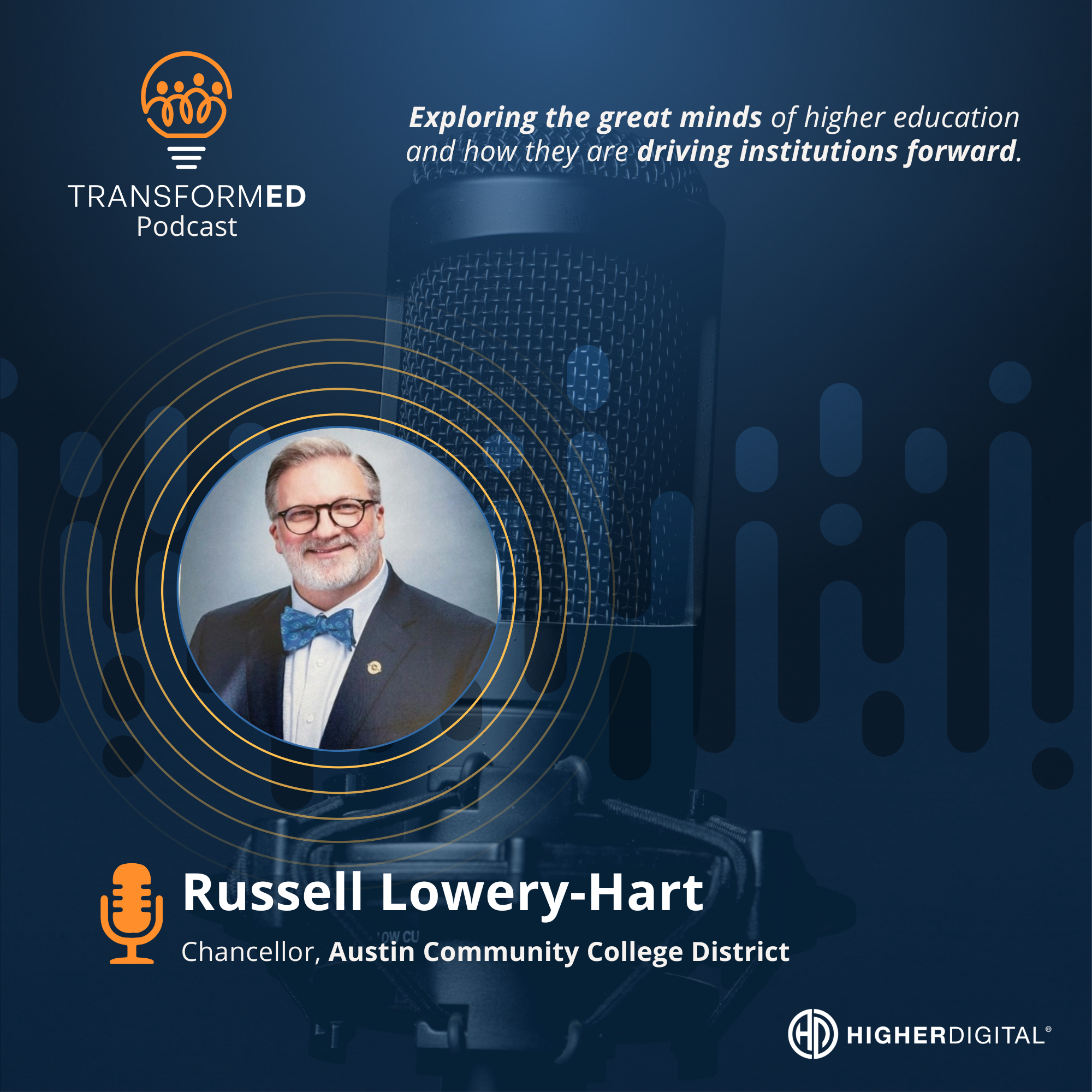
Higher Digital CEO & Co-Founder Wayne Bovier sits down with Dr. Russell Lowery-Hart, Chancellor of Austin Community College District, to explore why higher education’s biggest obstacle isn’t technology - it’s the bureaucratic systems institutions have built around themselves.
Bureaucracy Was Never the Goal
Dr. Lowery-Hart has a phrase for a pattern he sees across higher education. He calls it “higher-ed-ing.”
By that, he means the tendency to respond to every challenge with more processes, more policies, more reporting structures, more committees, more titles, and more bureaucracy.
In other words, higher education has become remarkably good at making complicated things even more complicated. And, in many cases, students pay the price.
His perspective was shaped long before he became a chancellor. His journey into leadership began in the classroom, where relationships with students fundamentally changed how he viewed the purpose of higher education.
As his career progressed, he realized that titles, organizational charts, and layers of authority often stood between institutions and the outcomes they were trying to achieve.
The problem wasn’t that structure existed. The problem was that structure became the priority. Over time, systems designed to support students gradually became systems designed to protect institutions.
Students Don’t Care About Organizational Charts
One of the strongest themes from our conversation was the importance of designing institutions around students rather than around internal processes.
Students don’t care who reports to whom. They don’t care about departmental boundaries. They don’t care how many approvals are required to solve a problem. They simply want institutions to help them succeed.
Dr. Lowery-Hart argued that colleges and universities spend enormous amounts of time and money teaching students how to navigate complicated systems when they could be redesigning those systems instead.
That shift in perspective changes everything. Instead of asking how students can adapt to the institution, institutions should ask how they can adapt to students.
Listening Became the Starting Point
When Dr. Lowery-Hart arrived at Austin Community College District, he didn’t begin by announcing a new strategy.
He started by listening.
Students described the obstacles they encountered. They shared the experiences that made them feel supported and the ones that left them frustrated. They helped define what success should look and feel like.
The institution then examined its own data through the lens of those experiences. From there, Dr. Lowery-Hart focused on empowering the people closest to the work.
Frontline employees, faculty members, and staff members were invited to help design solutions. Rather than reinforcing traditional hierarchies, the institution concentrated on removing barriers and creating greater alignment.
The goal wasn’t simply to improve operations. The goal was to create an institution that reflected the needs of the people it served.
AI Creates an Opportunity - If Institutions Use It Correctly
Dr. Lowery-Hart’s perspective on artificial intelligence was refreshingly practical.
He wasn’t interested in replacing people. He was interested in helping people spend more time being human.
Institutions devote enormous amounts of energy to repetitive processes, administrative work, and manual tasks that consume time without creating meaningful value for students. AI creates an opportunity to rethink those processes.
But simply layering AI on top of broken systems won’t solve the underlying problem. In fact, it may make existing inefficiencies even more visible.
Dr. Lowery-Hart argued that this moment gives higher education a chance to reimagine the way institutions operate while strengthening the relationships that matter most. Technology should support people. It should not distance them from one another.
Leadership Looks Different in Moments of Uncertainty
Dr. Lowery-Hart spoke openly about the temptation leaders often face to rely on authority, hierarchy, and control.
Over time, however, he discovered that meaningful change required something different. Leaders have to create conditions for success. They have to build trust. They have to remove obstacles. Most importantly, they have to remain focused on the people they serve.
That philosophy shaped one of the most powerful ideas from our conversation: institutions should be structured around loving students into success.
Not through slogans. Not through mission statements. Through action.
This Moment Matters
Higher education finds itself in an extraordinary moment. Public confidence is shifting. Students’ expectations are changing. Technology continues to accelerate. At the same time, institutions face growing pressure to prove their value and redefine their role in society.
Dr. Lowery-Hart sees opportunity in that uncertainty. The institutions willing to challenge old assumptions, simplify unnecessary complexity, empower their people, and remain relentlessly focused on students will be the institutions that thrive.
The others may find themselves overwhelmed by the very systems they created.
Final Thought
Higher education doesn’t need more bureaucracy. It needs more humanity.
The future won’t belong to the institutions with the most policies, the most committees, or the most complicated organizational structures. It will belong to the institutions that listen carefully, act courageously, and remember why they exist in the first place.
Because transformation has never been about the system itself. It’s always been about the people the system was built to serve.
Subscribe to TRANSFORMED wherever you get your podcasts to hear from higher ed leaders as soon as new episodes drop.