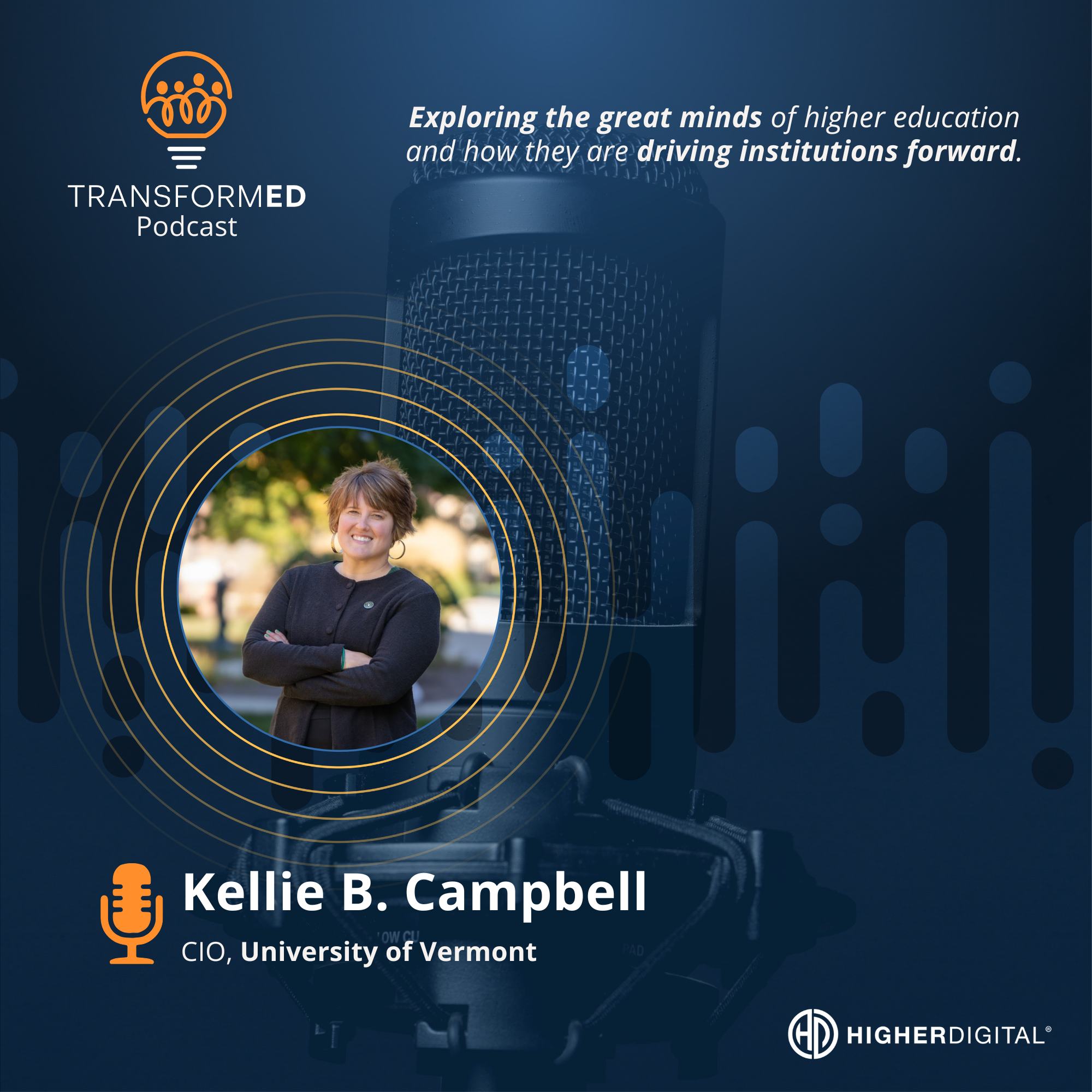
Higher Digital CEO & Co-Founder Wayne Bovier sits down with Dr. Kellie Campbell, CIO at the University of Vermont, to explore why higher education doesn’t have a strategy problem - it has an execution problem.
IT Isn’t a Support Function Anymore
One of the clearest themes from this conversation is something higher ed is still catching up to: IT is no longer infrastructure in the background. It is part of the operating system of the institution.
Kellie put it simply - technology sits in a unique position. It sees across academic, administrative, and operational systems. It sees what’s working. It sees what’s breaking. It sees where friction actually lives.
But the shift is this: that visibility only matters if it connects to strategy. Too often, IT is treated as something that “supports” strategy rather than shapes it. And that’s where execution starts to break down.
The Real Problem Isn’t Strategy. It’s Embedding It.
Most institutions don’t struggle to write a strategic plan. They struggle to embed it into daily work.
Kellie shared something important from her first year at UVM: she didn’t start by launching initiatives. She started by listening. From faculty. From students. From administrative teams. From IT staff.
And what came out of that wasn’t a traditional “strategy rollout.” It was a directional shift - a way of taking what the institution was already saying and building alignment around it.
But the real work wasn’t the plan. It was what came after. How do you actually make strategy show up across departments that don’t naturally operate together? How do you move from alignment on paper to coordination in practice?
Structure Is What Makes Strategy Real
One of the strongest ideas in this conversation is that execution is not just a people issue. It’s a structure issue.
Kellie talked about something that often gets overlooked in higher ed transformation: sustainability doesn’t come from enthusiasm. It comes from design.
- How teams are organized
- How decisions flow
- How work is prioritized
- How accountability is shared
At UVM, that meant rethinking parts of the IT organization itself - not just what it does, but how it is structured to support institutional priorities. Because without structure, even good strategy becomes optional in practice. And optional work rarely survives pressure.
From Projects to Continuous Change
Another major shift Kellie is driving is moving away from “project thinking.” Higher ed has traditionally operated in cycles: start a project, deliver it, move on.
But in a world of cloud systems, SaaS platforms, and continuous updates, nothing is ever really “done” anymore. So the question changes. It’s no longer: Did we complete the project? It becomes: Are we continuously improving the system we just changed?
That shift sounds simple. It isn’t. Because it requires a different mindset across the institution - not just in IT, but in academic leadership, finance, operations, and beyond.
The Role of PMO: From Tracking Work to Moving Work
Kellie also leads the PMO function - and the way she describes it is important. It’s not a reporting layer. It’s a delivery system. A way to connect strategy to execution in a structured, visible, and manageable way.
Because without that connection, institutions end up in a familiar pattern: too many projects, too few people, too little clarity, and constant overload.
The PMO becomes less about control - and more about capacity alignment. What gets done? What gets paused? What actually matters right now? And just as importantly - what needs to stop.
The Hardest Part of Execution: Letting Go
Most institutions don’t struggle to start work. They struggle to stop work. Everything feels important. Everything has history. Everything has ownership.
But when everything is a priority, nothing really is.
Kellie talked about the importance of deliberately identifying what to let go of - not just what to start next. Because execution is not just about adding capacity. It’s about protecting it.
Shared Accountability Changes Everything
Another key shift Kellie emphasizes is leadership structure. Not hierarchy. Not control. But shared accountability - the idea that execution doesn’t sit in one office. It lives across the institution.
That requires a cultural shift: from “who owns this?” to “how do we deliver this together?” It sounds simple. But it changes how work actually moves.
The Real Constraint Isn’t Capacity
One of the most common explanations in higher ed right now is “we don’t have enough capacity.” And sometimes that’s true. But more often, the issue is something else:
- How time is used
- How work is structured
- How decisions are made
- And what is allowed to continue even when it no longer serves the institution
Structure creates efficiency. Clarity creates speed. And letting go creates room for progress. Without those, capacity always feels like the problem - even when it isn’t.
Final Thought
Higher education doesn’t stall because it lacks intelligence. It stalls because execution is happening inside systems that were not designed for the pace of change today.
The institutions that move forward will not be the ones with the most plans. They will be the ones that build systems capable of continuously turning plans into action. Not once. Not in cycles. But consistently.
Because in this environment, strategy is no longer the differentiator. Execution is.
Subscribe to TRANSFORMED wherever you get your podcasts to hear from higher ed leaders as soon as new episodes drop.