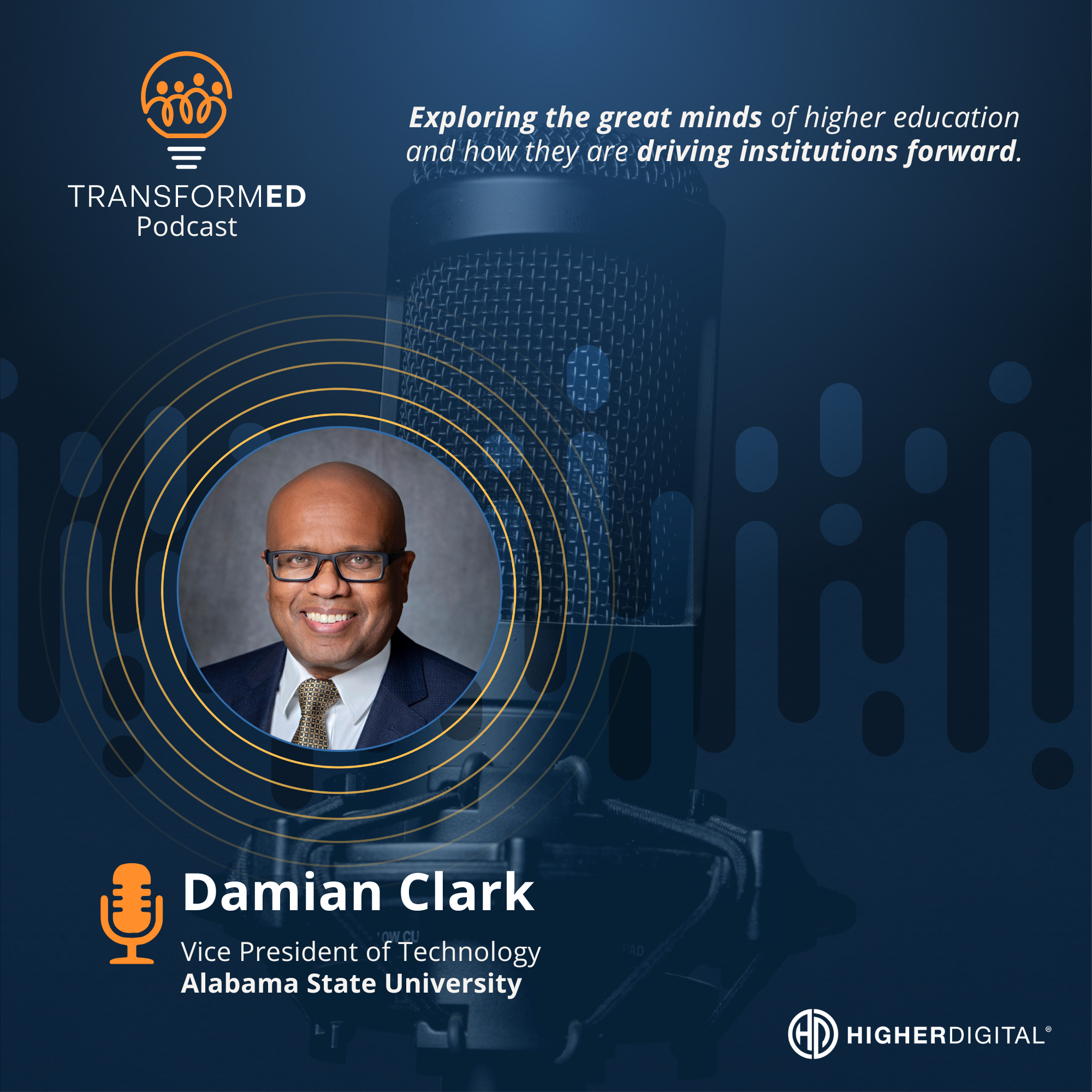
Higher Digital CEO & Co-Founder Wayne Bovier sits down with Damian Clark, Vice President of Technology at Alabama State University, to explore why AI isn’t transforming higher education - it’s exposing how institutions actually operate.
AI Isn’t Starting Change. It’s Revealing What Was Already Broken
One of the clearest ideas from this conversation is simple: AI doesn’t fix systems. It reveals them.
If your data is fragmented, AI shows you immediately. If your workflows are disconnected, AI amplifies the gaps. If your decisions are siloed, AI makes that visible at scale.
Damian puts it plainly - AI is not primarily an academic shift. It is an operational stress test for the institution. And most institutions are discovering issues they assumed were “manageable” are actually structural.
The Real Impact of AI Is Not in the Classroom
A lot of the public conversation about AI in higher education is focused on teaching and learning. But that’s not where Damian sees the biggest gains.
He points instead to operational environments:
- Enrollment management
- Student communication systems
- Financial aid processes
- IT service delivery
These are areas defined by repetition, volume, and fragmented decision-making. And that’s exactly where AI starts to surface value quickly. Not through theory - but through throughput.
The Problem Isn’t Technology. It’s Operating Design
Higher education is still largely built on decentralized operating models. Different units optimize for different outcomes. Admissions. Financial aid. HR. Academic departments. Each works effectively in isolation.
But AI forces something different: it connects what institutions historically kept separate. And when that happens, inefficiencies don’t just appear - they compound.
Damian’s point is direct: AI doesn’t create fragmentation. It exposes it. Which means the real question is no longer technical. It’s structural.
Prioritization Breaks Before Execution Does
One of the strongest themes in this conversation is how institutions actually make decisions. Most prioritization is still reactive. A system breaks. A leader escalates. A project becomes urgent. Repeat that pattern enough times, and everything becomes a priority.
Damian breaks this down clearly: the issue isn’t lack of ideas. It’s lack of sequencing. And when everything is urgent, execution stops being strategic - it becomes responsive.
That’s where institutions start to feel stuck, even when activity is high.
Small Use Cases Outperform Big AI Strategies
Instead of large-scale transformation programs, Damian points to something simpler: start small, start specific, start measurable.
The goal isn’t to “implement AI across the institution.” It’s to solve one problem well enough that it creates momentum. Examples include:
- Reducing response time in student inquiries
- Improving completion rates in application processes
- Automating high-volume administrative workflows
The pattern is consistent: clarity beats scale. Focused execution beats broad ambition.
Data Alignment Is the Real Foundation
Across every example in the conversation, one constraint shows up repeatedly: data alignment. Without connected, usable data, AI doesn’t scale. It fragments further. It increases risk. It exposes inconsistency faster than institutions can respond.
Damian is clear: AI doesn’t fail because of the model. It fails because of the data underneath it.
The Role of the CIO Has Changed
In this environment, the CIO is no longer just a technology operator. They are becoming translators between complexity and action. That means:
- Turning technical systems into institutional decisions
- Connecting siloed departments through shared outcomes
- Sequencing initiatives in environments of constant demand
- Helping leadership see trade-offs clearly
It’s not about controlling every initiative. It’s about making execution possible across competing pressures.
Final Thought
AI is not the transformation. It is the diagnostic. It shows institutions exactly how they operate - whether they’re ready or not.
And in that sense, the challenge is no longer adoption. It is alignment. Because institutions don’t fail when they lack tools. They fail when their systems can’t absorb what the tools reveal.
Subscribe to TRANSFORMED wherever you get your podcasts to hear from higher ed leaders as soon as new episodes drop.